Friday, 26 September 2014

To release the stress of an exhausting day

Five Easy Steps Enjoy luxurious bath Maybe this is not a luxury most expensive in the world, but the self-satisfaction that is created from a perfect bubble bath can make you feel good from head to toe. To release the stress of an exhausting day, do bubble bath at home. Dim the lights, light a candle, use LUX Velvet Touch and enjoy an elegant floral fragrance of Jasmine and Almond Oil sensual. Maybe you rarely do, but use the opportunity to pamper yourself by following these five steps, and get the perfect pleasure experience. 1.Turn off the cell phone and lock the bathroom door. There should be no interference; time on your hands. 2.Play your favorite music. Whether it's R & B, a romantic song, smooth jazz, or classical melody, music can deliver you to the place you want. 3.Lean, rest and enjoy the comfort of your neck with a magnificent backrest cushion terry cloth neck. 4.Sensual fragrances are an important part in the experience of a perfect bubble bath. You want to feel like what? Very feminine? So tempting? Choose a fragrance that suits your mood. 5.Place a thick and soft towels and bathrobes in range. Cover your body with something soft is its own comfort to finish your bubble bath experience. Follow the simple steps mentioned above to enjoy your relaxation time. Of course, you can share this experience with invites couples and enjoy it together. From : House of Lux
      The following websites were referenced in researching this book: Click Here!
http://de.acaiberryaktiv.com

http://www.lnk123.com/aff_c?offer_id=6&aff_id=306616

Thursday, 25 September 2014

Stress Pandemic: The Lifestyle Solution


Written by: AIS Member- Paul Huljich
Paul Huljich, AIS Member and co-founder of Best Corporation, (a pioneering organic foods company in New Zealand) has shared his personal story of leading his company to great success, while driving himself to a complete nervous breakdown.  This book is a hybrid:  Cautionary Tale/Guidebook for ordinary people who are living with chronic stress in their lives.  Mr. Huljich’s shares a vivid description of how unmanaged stress overtook his health and left him in a swift downward spiral, ultimately resulting in being institutionalized and diagnosed with bipolar disorder.  His story resonates with openness and honesty that can only come from someone who has “been there”.  Mr. Huljich rejected the grim recommendation to take psychotropic drugs for the rest of his life and began to research and explore natural ways to heal himself.  In this book, Mr. Huljich offers “9 Natural Steps” to become aware of the stressors in your life as well as empowering techniques to minimize their harmful health effects.  The preventative and restorative measures Mr. Huljich implemented to restore his health are well researched and scientifically proven to relieve stress and improve health.     Mr. Huljich represents AIS Membership well with this book.  Through his life experiences we can all learn the valuable lesson to manage the stress in our lives, before we manage to ruin our health.
- Kellie Marksberry, Executive Director, The American Institute of Stress

      The following websites were referenced in researching this book: Click Here!

Wednesday, 24 September 2014

8 Keys to Stress Management


8 Keys to Stress Management

Written by AIS Diplomate Elizabeth Scott
8 Keys to Stress Management written by Elizabeth Scott, MS, DAIS, is one empowering part of a series called “8 Keys to Mental Health.” It was written in Ms. Scott’s usual clear and accessible style and leads readers through the processes and challenges of making changes in their lives in order to manage and reduce the negative impact of stress. With each of her 8 Keys, Ms. Scott uses real world examples and evidence- based strategies to teach effective stress management techniques. The 8 Keys help readers recognize stressors and become aware of their power to reduce and reverse the impact of stress. Each chapter contains suggested activities, self administered questionnaires and helpful hints that prompt and encourage self- evaluation, shifts in perspective and personal growth. This book is a valuable resource that allows any reader to create a custom stress management plan so that they can enjoy the benefits of resolved or reduced stress. The book is designed to be effective for people who are busy and overwhelmed. It can be read cover to cover or in bits and pieces, skipping to Keys that seem more relevant at the time of reading. Ms. Scott has created a comprehensive resource that lends itself to easy reading and re-reading, through the inevitable stress induced peaks and valleys of happiness and contentment experienced in daily life.
 -Kellie Marksberry, Executive Director, American Institute of Stress


From article The American Institute of Stress

Tuesday, 23 September 2014

What is Stress?

What is Stress?

Stress is not a useful term for scientists because it is such a highly subjective phenomenon that it defies definition. And if you can’t define stress, how can you possibly measure it? The term “stress”, as it is currently used was coined by Hans Selye in 1936, who defined it as “the non-specific response of the body to any demand for change”. Selye had noted in numerous experiments that laboratory animals subjected to acute but different noxious physical and emotional stimuli (blaring light, deafening noise, extremes of heat or cold, perpetual frustration) all exhibited the same pathologic changes of stomach ulcerations, shrinkage of lymphoid tissue and enlargement of the adrenals. He later demonstrated that persistent stress could cause these animals to develop various diseases similar to those seen in humans, such as heart attacks, stroke, kidney disease and rheumatoid arthritis. At the time, it was believed that most diseases were caused by specific but different pathogens. Tuberculosis was due to the tubercle bacillus, anthrax by the anthrax bacillus, syphilis by a spirochete, etc. What Selye proposed was just the opposite, namely that many different insults could cause the same disease, not only in animals, but in humans as well.
Selye’s theories attracted considerable attention and stress soon became a popular buzzword that completely ignored Selye’s original definition. Some people used stress to refer to an overbearing or bad boss or some other unpleasant situation they were subjected to. For many, stress was their reaction to this in the form of chest pain, heartburn, headache or palpitations. Others used stress to refer to what they perceived as the end result of these repeated responses, such as an ulcer or heart attack. Many scientists complained about this confusion and one physician concluded in a 1951 issue of the British Medical Journal that, “Stress in addition to being itself, was also the cause of itself, and the result of itself.”

Unfortunately, Selye was not aware that stress had been used for centuries in physics to explain elasticity, the property of a material that allows it to resume its original size and shape after having been compressed or stretched by an external force. As expressed in Hooke’s Law of 1658, the magnitude of an external force, or stress, produces a proportional amount of deformation, or strain, in a malleable metal. This created even more confusion when his research had to be translated into foreign languages. There was no suitable word or phrase that could convey what he meant, since he was really describing strain. In 1946, when he was asked to give an address at the prestigious Collège de France, the academicians responsible for maintaining the purity of the French language struggled with this problem for several days, and subsequently decided that a new word would have to be created. Apparently, the male chauvinists prevailed, and le stress was born, quickly followed by el stress, il stress, lo stress, der stress in other European languages, and similar neologisms in Russian, Japanese, Chinese and Arabic. Stress is one of the very few words you will see preserved in English in these and other languages that do not use the Roman alphabet.

Because it was apparent that most people viewed stress as some unpleasant threat, Selye subsequently had to create a new word, stressor, to distinguish stimulus from response. Stress was generally considered as being synonymous with distress and dictionaries defined it as “physical, mental, or emotional strain or tension” or “a condition or feeling experienced when a person perceives that demands exceed the personal and social resources the individual is able to mobilize.” Thus, stress was put in a negative light and its positive effects ignored. However, stress can be helpful and good when it motivates people to accomplish more.

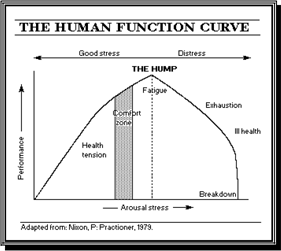
 As illustrated to the left, increased stress results in increased productivity – up to a point, after which things go rapidly downhill. However, that point or peak differs for each of us, so you need to be sensitive to the early warning symptoms and signs that suggest a stress overload is starting to push you over the hump. Such signals also differ for each of us and can be so subtle that they are often ignored until it is too late. Not infrequently, others are aware that you may be headed for trouble before you are.

Any definition of stress should therefore also include good stress, or what Selye called eustress. For example, winning a race or election can be just as stressful as losing, or more so. A passionate kiss and contemplating what might follow is stressful, but hardly the same as having a root canal procedure.

Selye struggled unsuccessfully all his life to find a satisfactory definition of stress. In attempting to extrapolate his animal studies to humans so that people would understand what he meant, he redefined stress as “The rate of wear and tear on the body”. This is actually a pretty good description of biological aging so it is not surprising that increased stress can accelerate many aspects of the aging process. In his later years, when asked to define stress, he told reporters, “Everyone knows what stress is, but nobody really knows.”

As noted, stress is difficult to define because it is so different for each of us. A good example is afforded by observing passengers on a steep roller coaster ride. Some are hunched down in the back seats, eyes shut, jaws clenched and white knuckled with an iron grip on the retaining bar. They can’t wait for the ride in the torture chamber to end so they can get back on solid ground and scamper away. But up front are the wide-eyed thrill seekers, yelling and relishing each steep plunge who race to get on the very next ride. And in between you may find a few with an air of nonchalance that borders on boredom. So, was the roller coaster ride stressful?

The roller coaster analogy is useful in explaining why the same stressor can differ so much for each of us. What distinguished the passengers in the back from those up front was the sense of control they had over the event. While neither group had any more or less control their perceptions and expectations were quite different. Many times we create our own stress because of faulty perceptions you can learn to correct. You can teach people to move from the back of the roller coaster to the front, and, as Eleanor Roosevelt noted, nobody can make you feel inferior without your consent. While everyone can’t agree on a definition of stress, all of our experimental and clinical research confirms that the sense of having little or no control is always distressful – and that’s what stress is all about.

      The following websites were referenced in researching this book:
From article The American Institute of Stress

Monday, 22 September 2014

Struggling with stress?

Stress 
 What is stress?

        Stress is the feeling of being under too much mental or emotional pressure. Pressure turns into stress when you feel unable to cope. People have different ways of reacting to stress, so a situation that feels stressful to one person may be motivating to someone else. Many of life’s demands can cause stress, particularly work, relationships and money problems. And, when you feel stressed, it can get in the way of sorting out these demands, or can even affect everything you do. Stress can affect how you feel, think, behave and how your body works. In fact, common signs of stress include sleeping problems, sweating, loss of appetite and difficulty concentrating.
         You may feel anxious, irritable or low in self esteem, and you may have racing thoughts, worry constantly or go over things in your head. You may notice that you lose your temper more easily, drink more or act unreasonably. You may also experience headaches, muscle tension or pain, or dizziness.
        Stress causes a surge of hormones in your body. These stress hormones are released to enable you to deal with pressures or threats – the so-called "fight or flight" response.
        Once the pressure or threat has passed, your stress hormone levels will usually return to normal. However, if you're constantly under stress, these hormones will remain in your body, leading to the symptoms of stress.

Managing stress in daily life 
       Stress is not an illness itself, but it can cause serious illness if it isn't addressed. It's important to recognise the symptoms of stress early. Recognising the signs and symptoms of stress will help you figure out ways of coping and save you from adopting unhealthy coping methods, such as drinking or smoking. Spotting the early signs of stress will also help prevent it getting worse and potentially causing serious complications, such as high blood pressure. There is little you can do to prevent stress, but there are many things you can do to manage stress more effectively, such as learning how to relax, taking regular exercise and adopting good time-management techniques. Studies have found that mindfulness courses, where participants are taught simple meditations across a series of weeks, can also help to reduce stress and improve mood. Read more about mindfulness. When to see your GP about your stress levels If you've tried self-help techniques and they aren't working, you should go to see your GP. They may suggest other coping techniques for you to try or recommend some form of counselling or cognitive behavioural therapy. If your stress is causing serious health problems, such as high blood pressure, you may need to take medication or further tests. Mental health issues, including stress, anxiety and depression, are the reason for one-in-five visits to a GP.

Recognising your stress triggers 
       If you're not sure what's causing your stress, keep a diary and make a note of stressful episodes for two-to-four weeks. Then review it to spot the triggers. Things you might want to write down include: the date, time and place of a stressful episode what you were doing who you were with how you felt emotionally what you were thinking what you started doing how you felt physically a stress rating (0-10 where 10 is the most stressed you could ever feel) You can use the diary to: work out what triggers your stress work out how you operate under pressure develop better coping mechanisms Doctors sometimes recommend keeping a stress diary to help them diagnose stress.

Take action to tackle stress
       There's no quick-fix cure for stress, and no single method will work for everyone. However, there are simple things you can do to change the common life problems that can cause stress or make stress a problem. These include relaxation techniques, exercise and talking the issues through. Find out more by checking out these 10 stress busters.
        Get stress support Because talking through the issues is one of the key ways to tackle stress, you may find it useful to attend a stress management group or class. These are sometimes run in doctors’ surgeries or community centres. The classes help people identify the cause of their stress and develop effective coping techniques. Ask your GP for more information if you're interested in attending a stress support group. You can also use the search directory to find emotional support services in your area. Read how 'workaholic' Arvind learned to deal with stress
      The following websites were referenced in researching this book:

Sunday, 21 September 2014

CONCLUSION


     If you’ve learned nothing from reading this book, we
hope you realize and understand that there is NO WAY to
completely eliminate stress from your life. What you can do
is to learn how to make that stress work FOR you.
Stress management isn’t as difficult as it might actually
seem. However, we can’t emphasize this next point enough.
If you think you have too much stress in your life, it may be
helpful to talk with your doctor, spiritual advisor, or local
mental health association. Because reactions to stress can
be a factor in depression, anxiety and other disorders, they
may suggest that you visit with a psychiatrist, psychologist,
social worker, or other qualified counselor.
     We don’t want to present ourselves as medical
professionals. All we want to do is give you some tools to
implement in your life to help you better cope with those
things that make us overwhelmed and feel out of control.
You may also want to look into time management tools
in order to get rid of some of your stressors. When we feel
like we don’t have enough time to do the things that need to
be done, that creates more stress and can lead to anxiety
which, believe me, you don’t want to have!
     Stress management tips are simple cost effective
methods to effectively check stress. They can be practiced
anywhere and at anytime. Well, almost!
     If you feel you are in need of help, do not hesitate. You
might not be correct always. The cause of your stress might
be for no reason at all. But it might be physical in its roots.
Someone else might be able to solve it easily. Understand
your limitations and it can relieve stress to a large extent.
Stress is a normal part of life. In small quantities,
stress is good -- it can motivate you and help you be more
productive. However, too much stress, or a strong response
to stress, is harmful.
     It can set you up for general poor health as well as
specific physical or psychological illnesses like infection,
heart disease, or depression. Persistent and unrelenting
stress often leads to anxiety and unhealthy behaviors like
overeating and abuse of alcohol or drugs.
Just like causes of stress differ from person to person,
what relieves stress is not the same for everyone. In
general, however, making certain lifestyle changes as well
as finding healthy, enjoyable ways to cope with stress helps
most people. I hope that I’ve given you some great ways of
dealing with the stress that we all feel!
     Above all, remember that you are in no way alone in
this battle. There are hundreds of thousands of people out
there who feel overwhelmed and nearly completely out of
control. That’s why we wanted to give you this book. So
you can find peace within yourself and realize that we’re all
on this big blue marble for a reason.
     You are too! Enjoy it and live life to its fullest. And
when you feel yourself stressed out or beset with a panic
attack, relax, breathe through it, and know that there are
many, many people who know exactly how you feel.
I like Bobby McFarrin’s philosophy best of all – “Don’t
Worry, Be Happy!”

      The following websites were referenced in researching this book:
www.articlegarden.com
www.ezinearticles.com
www.bzx.net
www.about.com
www.copingtoday.com

Saturday, 20 September 2014

RELAXING AT WORK


     Coffee breaks aren’t the only times when you can take
a moment for yourself. Experience has actually taught me
that coffee (or smoke) breaks can actually add to the stress
you feel when you’re at work.
     Some of the suggestions we’ve given you in this book
can certainly be practiced at work, but, unfortunately, others
cannot. Here’s a tried and true method to help you relax at
work.
     First and foremost, find a place to sit. Sit up straight
with your back against the back of your chair, your feet flat
on the floor, and your hands resting lightly on your thighs.
If possible, close your eyes. You may do the exercise
without closing your eyes, but closing your eyes will help
you relax a bit more. Do not clench your eyes shut. Let your
eyelids fall naturally.
     Breathe in slowly through your nose, counting to 5.
Hold the breath for a count of 5. Breathe out slowly,
counting to five. Repeat.
This exercise is performed by tensing and holding a set
of muscles for a count of 5, and then relaxing the set of
muscles for a count of 5.
     When you tense each muscle set, do it as hard as you
can without hurting yourself. When you release the hold, be
as relaxed as possible.
Begin by tensing your feet. Do this by pulling your feet
off the floor and your toes toward you while keeping your
heels on the floor. Hold for a slow count of 5. Release the
hold. Let your feet fall gently back. Feel the relaxation. Think
about how it feels compared to when you tensed the
muscles. Relax for a count of 5.
     Next tense your thigh muscles as hard as you can. Hold
for a count of 5. Relax the muscles and count to 5.
Tighten your abdominal muscles and hold for a count of
     5. Relax the muscles for a count of 5. Be sure you are
continuing to sit up straight.
Tense your arm and hand muscles by squeezing your
hands into fists as hard as you can. Hold for a count of 5.
Relax the muscles completely for a count of 5.
Tighten your upper back by pushing your shoulders
back as if you are trying to touch your shoulder blades
together. Hold for a count of 5. Relax for a count of 5.
Tense your shoulders by raising them toward your ears
as if shrugging and holding for a count of 5. Relax for a
count of 5.
     Tighten your neck first by gently moving your head
back (as if looking at the ceiling) and holding for 5. Relax for
5. Then gently drop your head forward and hold for 5. Relax
for a count of 5.
Tighten your face muscles. First open your mouth wide
and hold for 5. Relax for 5. Then raise your eye brows up
high and hold for 5. Relax for 5. Finally clench your eyes
tightly shut and hold for 5. Relax (with eyes gently closed)
for 5.
     Finish the exercise with breathing. Breathe in slowly
through your nose, counting to 5. Hold the breath for a
count of 5. Breathe out slowly, counting to five. Repeat 4
times. And that’s it!
     Perform this exercise whenever you need to relax,
whether it's on a plane or in a car or anyplace else you may
be sitting. Because this exercise may be very relaxing, it
should not be performed while driving.
     Over time, if performed regularly, this exercise will help
you recognize tension in your body. You will be able to relax
muscles at any time rather than performing the entire
exercise. Perform at least twice a day for long-term results.
You may develop your own longer relaxation exercise
by adding more muscle groups. Pinpoint your own areas of
tension then tense and relax these areas in the same way.
Maximize the relaxation benefits of this exercise by
visualizing a peaceful scene at the end of the exercise.
Visualize a scene - a place where you feel relaxed - in detail
for at least 5 minutes. Remember the happy place? Go
there and enjoy it!

Friday, 19 September 2014

TAKE A BREAK


     So often, we know inside ourselves that we need a
break. That break might be a full-fledged vacation or a
weekend getaway. Either way, getting out of the daily grind
can be amazingly liberating and a huge way to get rid of
stress and anxiety.
     Unfortunately, many people think they can’t take the
time to get away. This is toxic thinking. Get out and get
away!
How many times have you continued working, knowing
that you are not giving 100% to the task at hand? How
many times have you read or written the same sentence
over and over again, as your mind keeps wandering and
thinking about other things? How often have you wanted to
take a break from the family or kids but feared the
consequences of doing so? It’s time for a break!
     Why do we not allow ourselves the time to take a ‘time
out’? Perhaps we feel like we don’t deserve it or that there’s
just too much to be done. There are many genuine reasons
for needing to complete jobs and tasks; however we may
also on occasion have ‘hidden agendas’ as to why we cannot
stop for a break. Why?
It could be ego. Some people simply enjoy boasting
about, ‘how late they had to work in order to complete a
project’ or ‘how much effort they invested in order to
complete the job so quickly’. This type of person is often
looking to impress others with their efforts, thereby
increasing their ego in the process.
     Maybe you think you just can’t take the time off. "I
can’t stop; I just have to get this finished". Does this sound
familiar? "I can’t stop because the job has to be finished,
WHY? So I can move straight on to the next thing, and the
next, and the next etc…" This person will find that there is
always something that has to be done, which will constantly
prevent him/her from taking a break.
Maybe you just feel like you need to be needed. A
mother managing the household, kids and other chores may
feel as if her household will collapse if she were to put her
feet up or take a weekend off! By not taking a break she can
keep convincing herself that her role is crucial and the family
would collapse without her input. This may indeed be true,
but is still not a good enough reason to prevent her having a
rest!
     Get rid of that thinking! You can get some amazing
benefits just by taking a little time for yourself! Allowing
your mind and/or body to rest can help re-focus your
attention, sharpen your wits and increase motivation. In
addition, taking time out helps to relieve stress, can aid the
recovery of tired muscles and also promotes the discovery
that there is more to life than just work.
Many athletes will tell you that an important part of
their training routine is rest. Muscles need time to repair
after a workout. Remember that your brain is a type of
muscle as well. It needs time to rest and recuperate in
order to perform at its best. By giving your brain time off,
you’ll be able to better concentrate and give tasks you once
found difficult your full attention. They’ll be easier, believe
me!
     So you’ve decided that a break is in order. Good for
you! A break can be anything from a 10-minute meditation
session to a trip around the world, and anything in-between.
I think a break should be something that takes your mind off
of a preoccupation with the everyday tedium of life.
So depending on the time you wish to avail towards
relaxing you may enjoy reading, watching a movie, cooking,
playing with the kids, riding a motorbike or driving,
exercising or doing sports, traveling or simply sleeping!
While you are taking this rest, above all, allow yourself
the time to do it and don’t feel guilty about. You will gain so
very much by this time off, so enjoy the time you are giving
yourself.
     Life will go on without you and contrary to what your
mind might be telling you, everyone will survive – even
when you’re not there! Let everything go and concentrate
on YOU for once instead of everyone around you!
If you’re feeling tired, unmotivated or just in need of a
rest, don’t be a martyr or look negatively at this. You may
actually find that in reality, allowing yourself a break will
actually help you ultimately become more efficient and
effective in every part of your life. Plus you’ll get the badly
needed recharging of your “batteries” that you need and
sorely deserve!
     Work can probably be one of the most stressful places
to be. You might think that none of these techniques can
help you when you’re around your co-workers. You couldn’t
be more wrong.

Thursday, 18 September 2014

JUST SAY NO!


One huge problem people who are overly stressed out
have is the ability to say “No” when they need to. Maybe
your mother wants you to take Grandma to the store, but
you’re in the middle of a big work project. Perhaps your
best friend asks if you wouldn’t mind babysitting her kids
when you’ve already made plans with yourself to get a
haircut.
     There’s no reason why you have to say “Yes” to
everyone. In fact, there are often many times when you
should turn them down. If you find yourself agreeing to do
things when you really don’t want to, you’re a people
pleaser. In general, this isn’t a bad trait to have, but it can
be a huge stressor.
People pleasers think of other people’s needs before
their own. They worry about what other people want, think,
or need, and spend a lot of time doing things for others.
They rarely do things for themselves, and feel guilty when
they do. It’s hard being a people pleaser.
People pleasers hold back from saying what they really
think or from asking for what they want if they think
someone will be upset with them for it. Yet they often spend
time with people who don’t consider their needs at all. In
fact, people pleasers often feel driven to make insensitive or
unhappy people feel better - even at the detriment to
themselves.
            Constantly trying to please other people is draining and
many people pleasers feel anxious, worried, unhappy, and
tired a lot of the time. They may not understand why no one
does anything for them, when they do so much for others -
but they often won’t ask for what they need.
This is the trap I fell into. I found myself always
agreeing to do for others but when I needed those same
people to help ME out, they were curiously occupied.
A people pleaser may believe that if they ask someone
for help and that person agrees, that person would be giving
out of obligation, not because they really wanted to. The
thinking goes - if they really wanted to help, they would
have offered without my asking.
This line of thinking happens because people pleasers
themselves feel obliged to help and do not always do things
because they want to. Sadly, people pleasers have been
taught that their worth depends on doing things for other
people.
          It’s painful being a people pleaser – believe me, I
know! People pleasers are not only very sensitive to other
people’s feelings, and often take things personally, but they
also rarely focus on themselves.
When they do take a moment for themselves, they feel
selfish, indulgent, and guilty which is why they are often on
the go, rushing to get things done. Because people pleasers
accomplish so much and are easy to get along with, they are
often the first to be asked to do things - they are vulnerable
to be being taken advantage of.
People pleasers were most likely raised in homes where
their needs and feelings were not valued, respected, or
considered important. They were often expected as children
to respond to or to take care of other people’s needs. Or
they may have been silenced, neglected, or otherwise
abused, thus learning that their feelings and needs were not
important.
      In many cultures, girls are raised to be people pleasers
- to think of others’ needs first, and to neglect their own.
Many women have at least some degree of people pleasing
in them. Men who identified with their mothers often do as
well.
People pleasers’ focus is mostly on others and away
from themselves. They often feel empty, or don’t know how
they feel, what they think, or what they want for
themselves. But it’s possible to change this pattern and to
feel better about yourself.
      I managed to learn how to break out of this cycle. You
can do the same thing if you see yourself in the above
description. You want to know how? It’s easier than you
think!
First, practice saying NO. This is a very important word!
Say it as often as you can, just to hear the word come out of
your mouth. Say it out loud when you are alone. Practice
phrases with NO in them, such as, "No, I can’t do that" or
"No, I don’t want to go there". Try it for simple things first,
and then build your way up to harder situations.
Stop saying YES all the time. Try to pause or take a
breath before responding to someone’s request. You may
want to answer requests with "I need to think about it first,
I’ll get back to you" or "Let me check my schedule and call
you back". Use any phrase that you feel comfortable with
that gives you time before you automatically respond with
YES.
      Take small breaks, even if you feel guilty. You won’t
always feel guilty, but most likely in the beginning you will.
Remember that your mental health is well worth the
aggravation you may have to take from others. What’s
important is you. When you are healthy, those around you
will be healthy!
Figure out what gives you pleasure. For example, you
may like reading magazines, watching videos, going to a
park, or listening to music. Give yourself permission to do
those things and then enjoy them.
Ask someone to help you with something. I know this is
a hard one but you can do it! After all, everyone else is
asking YOU for favors, why shouldn’t YOU ask THEM? Just
be tolerant if they turn you down. Just because you have
always told them “Yes” doesn’t mean they always have to
tell you “Yes”.
      Check in with how you feel and what you are thinking.
It’s important to be aware of these things; they’re part of
who you are. And then try saying what you feel and think
more often. Just remember to have a little decorum in
certain situations.
Many people pleasers believe that nobody will like them
if they stop doing things for other people. If someone stops
liking you because you don’t do what they ask, then you’re
being used by them and probably don’t want them as a
friend anyway.
People will like you for who you are and not simply for
what you do. You deserve to take time to yourself, to say
NO, and to take care of yourself without feeling guilty. It’s
within your reach to change - one small step at a time!
I think most people would be in complete agreement
when I make this next statement. McDonald’s had it right –
You Deserve A Break Today!

Wednesday, 17 September 2014

WHO YA GONNA CALL? STRESS BUSTERS!


19. I really love this thought and have used it many
times myself! Yell! That’s right, scream at the top of
your lungs – as loud as you can. While this may not be
feasible in your home, it works great when you’re in
your car with the windows rolled up. Let out a guttural
yelp from deep down inside. It’s liberating!
20. Sing. As we said in the previous chapter, music
can be extremely beneficial when getting rid of stress.
Think how much better you can feel when you belt out
“Copacabana” at the top of your lungs! Who cares if
you can’t carry a tune? You’re doing this for you!
21. Take up a new hobby like knitting or crocheting.
Don't worry about being good at it. It's the process
that's beneficial. Sitting still while performing repetitive
movements is calming and stabilizing for many people.
It can be time to collect your thoughts.
22. Start a garden. Even apartment-dwellers can do
this. Inside in pots, pots on the patio, pots, a small
spot in your yard. There is a little work to setting it up.
Tending plants, fruits, vegetables, flowers and
watching them grow, bloom, or yield food is rewarding.
Avid gardeners say working a garden is the best way to
control stress and worry. An added benefit is the
creation of a more beautiful, restful environment.
23. Play with a dog or cat. Experts say pet owners
have longer lives and fewer stress symptoms that nonpet
owners. Playing with your pet provide good
vibrations – for you and for the pet! It’s a form of
social interaction with no pressure to meet anyone’s
expectations!
24. Look at the stars and the moon. It can be a very
humbling experience to lay on a blanket with your
hands behind your head and gaze up into the night sky.
It’s more than humbling; it’s downright beautiful and
relaxing!
Just the other night, my grandson and I got a
blanket out and lay in the yard looking at the moon
going behind the clouds and gazing at the stars. He’s
only three, so it’s a fascinating experience for him, but
looking at the sky through his eyes made it even more
fascinating for me.
I could feel all my worries melting away as we
chatted about the astronauts that get to see the stars
close up and how big the universe is while we remain
so small. When you look at the vastness of the sky,
you realize that our problems are small compared to
that. I also get great comfort from seeing that one
bright star in the sky that is always above my house.
When my best friend’s mother died, we got out of
the car after coming from her visitation and my friend’s
five-year old and I stopped to star gaze. She pointed
out one particular star and said “That’s my grandma.
She’s our guardian angel now.” Every time I see that
star, I know Cheryl’s there and she’ll help get me
through anything!
25. Treat yourself to some comfort food. But be
careful or over-eating could become your big stressor.
Enjoy in moderation and make yourself feel better.
I love mashed potatoes and gravy and macaroni
and cheese. Those are my comfort foods. But I make
sure that I don’t overdo it. I give myself just enough to
bring on that calming feeling.
26. Swing. Remember the feeling of sitting inside that
little piece of leather on the playground as you sway
back and forth and feel the wind whipping through you
hair? Do that! If you don’t have a swing in your yard,
go to a playground and remember to pump your legs
back and forth to see how high you can go. It’s
liberating!
27. Take a candle lit bubble bath. Even you guys out
there can benefit from a warm bath bathed in the soft
glow of candlelight. Lay your head back, feel the
bubbles and the warm water, and let your stress go
right down the drain when you pull the plug!
Phew! There you have twenty-seven ways to relax and
de-stress! You can come up with your own ways as well!
The key, really, is to find something that makes you feel
better when you are overwhelmed and practice that method
faithfully. You’ll be a healthier person overall.

Tuesday, 16 September 2014

MORE STRESS MANAGEMENT


6. Make stress your friend
Acknowledge that stress is good and make stress your
friend! Based on the body’s natural “fight or flight”
response that burst of energy will enhance your
performance at the right moment. I’ve yet to see a top
sportsman totally relaxed before a big competition. Use
stress wisely to push yourself that little bit harder when
it counts most.
7. Stress is contagious
What we mean by this is that negative people can be a
huge stressor. Negativity breeds stress and some
people know how to do nothing but complain. Now you
can look at this in one of two ways. First, they see you
as a positive, upbeat person and hope that you can
bring them back “up”. If that’s not it, then they’re just
a negative person and can’t feel better about
themselves unless those around them are negative as
well.
Don’t get caught up in their downing behavior.
Recognize that these kinds of people have their own
stress and then limit your contact with them. You can
try to play stress doctor and teach them how to better
manage their stress, but be aware that this may
contribute more to your own stress, so tread lightly.
8. Copy good stress managers
When people around are losing their head, which keeps
calm? What are they doing differently? What is their
attitude? What language do they use? Are they trained
and experienced?
Figure it out from afar or sit them down for a chat.
Learn from the best stress managers and copy what
they do.
9. Use heavy breathing.
You can trick your body into relaxing by using heavy
breathing. Breathe in slowly for a count of 7 then
breathe out for a count of 11. Repeat the 7-11
breathing until your heart rate slows down, your
sweaty palms dry off and things start to feel more
normal.
10. Stop stress thought trains
It is possible to tangle yourself up in a stress knot
all by yourself. “If this happens, then that might
happen and then we’re all up the creek!” Most of these
things never happen, so why waste all that energy
worrying needlessly?
Give stress thought-trains the red light and stop
them in their tracks. Okay so it might go wrong – how
likely is that and what can you do to prevent it?
11. Know your stress hot spots and trigger points
Presentations, interviews, meetings, giving
difficult feedback, tight deadlines……. My heart rate is
cranking up just writing these down!
Make your own list of stress trigger points or hot
spots. Be specific. Is it only presentations to a certain
audience that get you worked up? Does one project
cause more stress than another? Did you drink too
much coffee?
Knowing what causes your stress is powerful
information, as you can take action to make it less
stressful. Do you need to learn some new skills? Do you
need extra resources? Do you need to switch to decaffeinated
coffee?
12. Eat, drink, sleep and be merry!
Lack of sleep, poor diet and no exercise wreaks
havoc on our body and mind. Kind of obvious, but
worth mentioning as it’s often ignored as a stress
management technique. Listen to your mother and
don’t burn the candle at both ends!
Avoid using artificial means to dealing with your
stress. That means don’t automatically pour a glass of
wine when you think you’re getting stressed out and
don’t light up a cigarette. In actuality, alcohol,
nicotine, caffeine, and drugs can make the problem
worse. A better idea is to practice the relaxation
techniques we’ve given you. Then, once you’re
relaxed, you can have that glass of wine if you want.
13. Go outside and enjoy Mother Nature. A little
sunshine and activity can have amazing ramifications
on your stress level and will enhance your entire
outlook towards life. Your improved attitude will have a
positive effect on everyone in your family and/ or circle
of friends; things which seem overwhelming will soon
become trivial matters, causing you to wonder what the
predicament was.
Not only will you be less stressed, you will be
healthier, happier, and more energetic; ready to face
whatever obstacles come your way.
14. Give yourself permission to be a 'kid' again. What
did you enjoy when you were a child? Draw; paint; be
creative. Play with Play- dough, dance, or read. Play
music, allow yourself freedom to express yourself
without worry that you're not keeping with the image of
who you are 'supposed' to be. Just relax and enjoy
yourself. We all have a little child in us and it's a good
idea to allow expression of the child within from time to
time.
If I might say so, this suggestion is excellent and
very therapeutic. I speak from experience. I can tell
you that there is nothing more satisfying than buying a
brand new box of 64 Crayons – the one with the
sharpener in the box – and coloring away in a coloring
book. My grandson loves it when I use this stress
buster!
15. Don't set unrealistic for goals for yourself. Many of
us set ourselves up for defeat simply by setting
unrealistic goals for ourselves. For example, if you are
dieting, realize you cannot lose 40 pounds in one or
two months.
Or maybe you are trying to reach a goal of
obtaining a particular job position; whatever your goal
is allow sufficient time to reach your goals and realize
occasional setbacks may occur.
If you reach your goal without any delays, you will
be even happier with yourself for arriving quicker than
you planned, but don't expect it. In fact don't expect
anything; expectations and reality are often two
entirely different things.
16. Learn it is OK to say 'no' occasionally. Often,
many of us feel we have to say 'yes' to everyone, every
time we are asked for help and feel that we must
respond in a positive fashion. But, remember, you
cannot be all things to all people. You must first meet
your own needs before you can truly give others what
they need while at the same time keeping yourself
happy.
17. You do not have to do everything your family,
friends, and others ask. Of course you can help others,
but first make sure you have done what is necessary to
take care of yourself.
18. Make time for yourself, your number one priority;
once your own needs are met you will find you have
more time for others. And you may find more pleasure
in helping others when you don't feel that you must
always put others needs before your own.
We’re not done yet! There are so many great ways to
combat stress and anxiety. You deserve to get all the
information you can. After all, that’s really why you’re
reading this book, isn’t it? Here’s some more stress busters.

Monday, 15 September 2014

STRESS MANAGEMENT


As we’ve said before, stress is a part of life. There’s no
getting away from it. In fact, some stress is good stress.
You may not believe that, but sometimes stress can
motivate us to do things we may not normally do in a
relaxed state. Stress can make us brave enough to go
forward when normally we might hesitate.
We have to be resilient in order to effectively cope with
stress and help it enhance our life instead of control it. How
do you get strong and resilient? By learning how to take
control of your stress and make it work FOR you instead of
AGAINST you.
Recognizing stress symptoms can be a positive
influence in that we're compelled to take action – and the
sooner the better. It's not always easy to discern why you
have the stress in each situation but some of the more
common events that trigger those emotions are the death of
a loved one, the birth of a child, a job promotion, or a new
relationship. We experience stress as we readjust our lives.
Your body is asking for your help when you feel these stress
symptoms.
We’re going to give you many suggestions in this
chapter. Not all of them will work for you, but we’re willing
to bet that some of them will.
There are three major approaches to manage stress.
The first is the action-oriented approach. In this method, the
problems that cause stress are identified and necessary
changes are made for a stress free life.
The next approach is emotionally oriented and in it, the
person overcomes stress by giving a different color to the
experience that caused stress. The situation, which causes
stress, is seen humorously or from a different angle.
I especially advocate this approach to stress
management. Sometimes if you don’t laugh at a situation,
you’ll cry – uncontrollably. That’s no solution. So learn to
see the humor instead of the doom.
The third way is acceptance-oriented approach. This
approach focuses on surviving the stress caused due to
some problem in the past.
The first stress management tip is to understand the
root cause of your stress. No one understands your problem
better than you do. A few minutes spend to recognize your
true feelings can completely change the situation.
During this process, identify what triggered the stress.
If someone close to your heart is nearby share it with the
person. If you are overstressed and feel you are going to
collapse, take a deep breath and count till ten. This pumps
extra oxygen into your system and rejuvenates the entire
body.
When under severe stress meditate for a moment and
pull out of the current situation for a little while. Stand up
from your current position and walk. Stretch yourself. Soon
you will find that the stress has lessened.
This is because you have relaxed now and relaxation is
the best medicine for stress. Smiling is yet another way of
stress management. If you are at the work place, just stand
up and smile at your colleague in the far corner. You will see
a change in your mood. Learn some simple yoga or
mediation techniques.
You can also invent your own stress management tips.
The basic idea is to identify the cause of stress and to pull
out from it for a moment and then deal with it. Taking a
short walk and looking at objects in nature is another stress
reliever. Drinking a glass of water or playing small games
are simple stress management techniques. The whole idea is
change the focus of attention and when you return to the
problem, it does not look as monstrous as you felt before.
Here are five quick steps you can take toward relieving
stress:
1. Don’t just sit there. Move! According to many
psychologists, motion creates emotion. You might
notice that when you are idle, it’s easier to become
depressed. Your heart rate slows down, less oxygen
travels to your brain, and you are slumped somewhere
in a chair blocking air from reaching your lungs.
I challenge you right now, regardless of how you are
feeling, to get up and walk around at a fast tempo.
Maybe you might want to go to an empty room and
jump up and down a little bit. It may sound silly but the
results speak for themselves. Try it now for a few
minutes. It works like magic.
Exercise can be a great stress buster. People with
anxiety disorders might worry that aerobic exercise
could bring on a panic attack. After all, when you
exercise, your heart rate goes up, you begin to sweat,
and your breathing becomes heavier.
Don’t panic – it’s not an attack! Tell yourself this over
and over while you’re exercising. Realize that there’s a
big difference between the physical side of exercise and
what happens when you exercise.
2. Smell the roses. How do you smell the roses? How
about investing some money to go on that one trip
you’ve been dreaming about? Visit a country with lots
of exotic places to jolt your imagination and spur your
creativity. You need to detach from your daily activities
and venture a little bit.
3. Help others cope with their problems. It is very
therapeutic when you engross yourself in helping
others. You will be surprised how many people’s
problems are worse than those you may be facing. You
can offer others assistance in countless ways. Don’t
curl up in your bed and let depression and stress take
hold of you.
Get out and help somebody. But be careful. Don’t get
caught up in other people’s problems in an attempt to
forget about your own.
I am constantly being called by friends and family when
they want to vent or get advice. I joke and tell them
“Don’t call the ‘crazy’ person for advice!” But there are
times that I find myself worrying about the ones who
call me and I get caught up in what they’re going
through. This just gives me more stress than I already
have and I find that I have to step away and re-assess
myself and my priorities.
I’m now to the point where I can tell them that I just
can’t deal with it right now and to call back later.
Sometimes, they get upset, but more often than not,
they understand. But I’ve learned not to get too upset
about their reactions. If it won’t matter in a week, it
should matter right now.
4. Laugh a little. By now you’ve heard that laughter is a
good internal medicine. It relieves tension and loosens
the muscles. It causes blood to flow to the heart and
brain. More importantly, laughter releases a chemical
that rids the body of pains.
Every day, researchers discover new benefits of
laughter. Let me ask you this question: “Can you use a
good dose of belly-shaking laughter every now and
then?” Of course you can. What you are waiting for? Go
a comedy club or rent some funny movies.
5. Wear your knees out. If there were one sustainable
remedy I could offer you when the going gets tough, it
would be prayer. Many people, depending on their
faith, might call it meditation. It doesn’t matter to me
what you call it, as long as you have a place to run to.
There you have a few quick fixes when you’re feeling
stressed. Want more? No problem!

Sunday, 14 September 2014

4. Termination


Once you have finished applying suggestions you are
through with your induction and you can terminate your
session. You could just open your eyes, get up and go
about your business, but that is not a good idea.
You should formally identify the end of every session.
By doing this you provide a clear boundary between the
hypnotic state and your ordinary conscious awareness. A
clear termination also prevents your self-hypnosis practice
session from turning into a nap. If you want to take a nap,
take a nap. But don't do it in a way that sleeping becomes
associated with self-hypnosis practice.
If you are practicing at bedtime and don't care if you
go on to sleep, that is okay. But still draw the line in your
mind to indicate the end of your self-hypnosis session.
To terminate the session, think to yourself that you are
going to be fully awake and alert after you count up to,
say, three.
"One, I'm beginning to come out of it, moving toward a
waking state. Two, I'm becoming more alert, getting ready
to wake up. Three, I'm completely awake." Something like
that.
Self-hypnosis can work wonders when it is practiced on
a regular basis. You’d be amazingly surprised at the level
of relaxation you can get to. It’s one of the best things I
ever did for myself!
Now we should move on to stress management
techniques in general. This could be a long chapter, but a
very, very helpful one!

Saturday, 13 September 2014

3. Suggestion Application in self-hypnosis


Once you have reached the end of your deepening
procedure you are ready to apply suggestions. What you
have done during the relaxation and deepening procedures
is increase your suggestibility. That is, you have opened up
your subconscious mind at least a little bit to receive your
suggestions. This works because of the particular, and
peculiar, characteristics of the subconscious part of your
mind.
The most common and easiest way to apply
suggestions is to have them worked out ahead of time,
properly prepared and worded, and memorized. It should
not be too difficult to remember them because they should
be rather short and you are the one who composed them.
If you have them ready and remembered, you can simply
think your way through them at this point.
Dialogue, or more properly monologue, is also okay.
You just talk ("think" to keep your effort to a minimum) to
yourself about what it is you want to do, be, become,
whatever.
Don't say "you." You are thinking to yourself, so use
the first person personal pronoun "I." Some suggestions
can be succinctly stated in a somewhat more formal sort of
way, like, "I am eating less and becoming more slender
every day."
Elaborated suggestions are generally wordier and more
of an ad lib: "Food is becoming less important to me every
day and I am filling my time with more important and
meaningful pursuits than eating. It is getting easier and
easier to pass up desserts and other fattening foods . . ."
and so on.
Generally speaking, the most effective kind of
suggestion is image suggestion. Image suggestions usually
do not use language at all. You can liken this to seeing
yourself in a calm, relaxed state while in the middle of a
chaotic situation. Actually see yourself in your mind’s eye.
Although people sometimes see immediate results from
their suggestions, it is more likely to take a little time for
them to kick in. So don't be impatient. On the other hand,
if you have not begun to see some results within, say, a
couple of weeks, you need to change your suggestions.

Friday, 12 September 2014

2. Deepening Procedures


Once you have completed the relaxation phase of your
self-hypnosis induction procedure, you can begin to
deepen the relaxed state. At some time between the deep
relaxation and the deepening procedures you will move
into a hypnotic state. You probably won't know it,
especially as a beginner, but it will happen sooner or later.
One of the first hurdles a beginner must get over is
the compulsion to "watch for it." That is, you will keep
waiting for hypnosis to happen, for some change in your
awareness or the way you feel that will say to you, "You're
hypnotized."
Watching for hypnosis will definitely get in your way if
you don't get it out of your mind. Going into a hypnotic
state is, in this respect, similar to going to sleep. If you try
to catch yourself going to sleep – if you try to be aware of
the precise instant in which you actually go to sleep – you
are much less likely to go to sleep. "Watching" keeps you
awake.
In this same way you will not know when you go into a
hypnotic state (but that won't be because you lost
consciousness – you won't). Later, after you have been
practicing regularly for a few weeks or a month or two,
you'll be much more familiar with yourself and how it feels
to be hypnotized.
Does it take everyone weeks or even months to get
into a good hypnotic state? Definitely not. Some people
have an amazing experience the very first time they try it.
Others might practice for several days, noticing nothing,
then out of the blue they have one of those great induction
sessions in which they know something stupendously good
happened. But if you happen not to be one of these
people, don't worry about it. Just keep practicing and you
will eventually get there.
One of the most popular deepening procedures is the
count-down technique. Hollywood also likes this one. That
is why you see it in so many movies. That and the
swinging watch.
To use the count-down technique you simply start
counting downward from, say, 20 (or 100, or whatever).
Adjust the countdown number to whatever feels right to
you after you have practiced a few times. Imagine that you
are drifting deeper with each count. Other images and
thoughts will probably intrude themselves as you count.
That is natural. Just gently brush them aside, continuing
with your counting.
The speed with which you count down should be
natural; not too fast, not too slow. For most people this
means counting at a rate of about one count for each two
or three seconds. Do it at a rate that feels comfortable and
relaxed to you. Some people like to tie the count with their
breathing. As they drift deeper their breathing slows down,
so their counting also slows down.
Don't count out loud, just think your way down the
count. You want to avoid as much physical involvement
and movement as possible.

Thursday, 11 September 2014

1. Relaxation


Your first job in the hypnotic induction is to slow the
juices down and get yourself relaxed. But don't try to force
your mind to relax (whatever that means)! If you get
yourself physically relaxed, your mind will follow.
Relaxation – really deep relaxation – is an ability that
most people have either lost or never developed. Some
people can do it quite easily, though. They just let go of
their tensions and let every part of their body become limp
and relaxed. If you are one of these people, begin your
self-hypnosis practice by getting nicely relaxed. Take your
time. This is not something you want to rush.
The time involved for the relaxation phase of your selfhypnosis
induction can vary from half an hour to just a few
seconds. It is an important part of the induction and
should not be slighted. As you get better and your skill
increases you will recognize deeply relaxed states, and you
will be able to achieve them in a surprisingly short time.
But as a beginner, take your time. It will be time well
spent.
A very popular method of deep relaxation is the
Jacobson Progressive Relaxation procedure. This involves
tensing each of the major muscle groups of your body
(foot and lower leg on each side, upper leg and hip,
abdomen, etc.). Tense the muscle group for a few
seconds, then let go.

Wednesday, 10 September 2014

SELF-HYPNOSIS FOR STRESS


A few weeks ago, I was feeling particularly
overwhelmed with stress and anxiety. It seemed like
anything that could go wrong, did go wrong. I felt like I was
spinning out of control.
I happened to be writing a book on yoga and
meditation at the time and came across a website that
offered a downloadable mp3 hypnotic relaxation session. It
cost me about $20 and it was the best $20 I have ever
spent!
There are plenty of places on the internet where you
can get these downloadable sessions for a small fee.
However, you can also practice self-hypnosis on your own.
You first need to find a quiet place where you can fully
relax and listen to your inner voice. You shouldn’t TRY to
make something happen. Let your mind listen and relax. A
large part of achieving that hypnotic state is to allow it to
happen naturally.
Also, don’t watch for certain signs or signals that you
might be in a hypnotic state. We can guarantee that if you
look for these signs, you won’t be able to fully relax and gain
the benefits of self-hypnosis.
There are lots of different ways to experience hypnosis.
No two people will have exactly the same experience. In
one respect, though, everyone has the same experience:
the hypnotic state is always pleasant! There are no "bad
trips" in hypnosis. Keep in mind that self-hypnosis is a
skill, and that you will continue to get better at it and, as
you do, it becomes ever more powerful.
It's a good idea to set up a schedule of practice,
allowing yourself anywhere between 10 and 30 minutes,
depending on how busy you are and how much time you
have to spend at it. Practice during the best part of your
day if you can and at a time when you are least likely to be
disturbed by others.
Most people find it best to practice lying down, in a
comfortable position, with as few distractions as possible.
If you are bothered by noise while you practice you can try
to mask out the noise with some other source of sound.
You can try stereo music in the background, or white
noise if you like. If like most people you don't have a white
noise generator, try tuning a radio receiver between
stations. The static you get when you do that is similar to
white noise. However this takes an older or cheaper FM
receiver without a noise suppressor. Sometimes AM tuners
can be used for this. This should just be in the background
and not too loud to be distracting.
The basic divisions of a hypnotic induction are
relaxation, deepening, suggestion application, and
termination.

Tuesday, 9 September 2014

USING MUSIC TO BEAT STRESS


Listening to music does wonder to alleviate stress.
Everyone has different tastes in music. We should listen to
the music that makes us feel comfortable. Sitting down and
forcing yourself to listen to relaxation music that you don't
like may create stress, not alleviate it. Music is a significant
mood-changer and reliever of stress, working on many
levels at once.
The entire human energetic system is extremely
influenced by sounds, the physical body and chakra centers
respond specifically to certain tones and frequencies. Special
consideration should be given to the positive effects of one
actually playing or creating music themselves.
Among the first stress-fighting changes that take place
when we hear a tune is an increase in deep breathing. The
body's production of serotonin also accelerates.
Playing music in the background while we are working,
seemingly unaware of the music itself, has been found to
reduce the stress of the workplace. That’s why so many
retail places play music while you shop – to take your mind
off the high prices!
Music was found to reduce heart rates and to promote
higher body temperature - an indication of the onset of
relaxation. Combining music with relaxation therapy was
more effective than doing relaxation therapy alone.
Many experts suggest that it is the rhythm of the music
or the beat that has the calming effect on us although we
may not be very conscious about it. They point out that
when we were a baby in our mother's womb, we probably
were influenced by the heart beat of our mother. We
respond to the soothing music at later stages in life, perhaps
associating it with the safe, relaxing, protective environment
provided by our mother.
Music can be one of the most soothing or nerve
wracking experiences available. Choosing what will work for
any individual is difficult, most will choose something they
'like' instead of what might be beneficial.
In doing extensive research on what any given piece of
music produces in the physiological response system many
unexpected things were found. Many of the so-called
meditation and relaxation recordings actually produced
adverse EEG patterns, just as bad as Hard Rock and Heavy
Metal.
The surprising thing was many selections of Celtic,
Native American as well as various music containing loud
drums or flute were extremely soothing. The most profound
finding was any music performed live and even at
moderately loud volumes even if it was somewhat discordant
had very a beneficial response.
As we mentioned before, there is not a single music
that is good for everyone. People have different tastes. It is
important that you like the music being played. I recently
picked up a rest and relaxation CD at Wal-Mart that has
done wonders for me. It has the sounds of the ocean in the
background while beautiful piano music plays. It’s very
soothing.
One note here, it’s probably not a good idea to play
certain types of ballads or songs that remind you of a sad
time in your life when you’re trying to de-stress. The reason
is obvious. You’re trying to relax and wash away the
anxious thoughts. The last thing that you need is for a sad
song to bring back memories you don’t need anyway.
Here are some general guidelines to follow when using
music to de-stress.
• To wash away stress, try taking a 20-minute
"sound bath." Put some relaxing music on your
stereo, and then lie in a comfortable position on a
couch or on the floor near the speakers. For a
deeper experience, you can wear headphones to
focus your attention and to avoid distraction.
• Choose music with a slow rhythm - slower than
the natural heart beat which is about 72 beats per
minute. Music that has repeating or cyclical
pattern is found to be effective in most people.
• As the music plays, allow it to wash over you,
rinsing off the stress from the day. Focus on your
breathing, letting it deepen, slow and become
regular. Concentrate on the silence between the
notes in the music; this keeps you from analyzing
the music and makes relaxation more complete.
• If you need stimulation after a day of work, go for
a faster music rather than slow calming music.
Turn up the volume and DANCE! It doesn’t matter
if you can actually dance or not. Just move along
with the music and do what feels good. You’ll be
shocked at the release you can feel!
• When going gets tough, go for a music you are
familiar with - such as a childhood favorite or
favorite oldies. Familiarity often breeds calmness.
• Take walks with your favorite music playing on the
walkman. Inhale and exhale in tune with the
music. Let the music takes you. This is a great
stress reliever by combining exercise (brisk walk),
imagery and music.
• Listening to the sounds of nature, such as ocean
waves or the calm of a deep forest, can reduce
stress. Try taking a 15- to 20-minute walk if
you're near the seashore or a quiet patch of
woods. If not, you can buy tapes of these sounds
in many music stores. This has been very calming
for me – you should try it too!
There’s another great relaxation technique that I have
found in coping with my own anxiety problems: selfhypnosis.

Monday, 8 September 2014

CALM YOURSELF WITH VISUALIZATION


The purpose of visualization is to enable you to quickly
clear mental stress, tension, and anxious thinking. The
visualization can be used when feeling stressed and is
particularly useful when your mind is racing with fearful,
anxious thinking.
This visualization process, when practiced frequently, is
very effective for eliminating deep-seated mental anxieties
or intrusive thoughts. To gain maximum benefit, the
exercise must be carried out for longer then 10 minutes at a
time, as anything shorter will not bring noticeable results.
There is no right or wrong way to carry out the
visualization. Be intuitive with it and do not feel you are
unable to carry it out if you feel you are not very good at
seeing mental imagery. As long as your attention is on the
exercise, you will gain benefit.
It is best to do this exercise in a quiet place where you
won’t be disturbed, and then when you are more practiced
you will be able to get the same positive results in a busier
environment such as the workplace. You should notice a
calming effect on your state of mind along with a sensation
of mental release and relaxation.
Either sitting or standing, close your eyes and move
your attention to your breath. To become aware of your
breathing, place one hand on your upper chest and one on
your stomach. Take a breath and let your stomach swell
forward as you breathe in and fall back gently as you
breathe out. Take the same depth of breath each time and
try to get a steady rhythm going.
Your hand on your chest should have little or no
movement. Again, try to take the same depth of breath each
time you breathe in. This is called Diaphragmatic Breathing.
When you feel comfortable with this technique, try to
slow your breathing rate down by instituting a short pause
after you have breathed out and before you breathe in
again. Initially, it may feel as though you are not getting
enough air in, but with regular practice this slower rate will
soon start to feel comfortable.
It is often helpful to develop a cycle where you count to
three when you breathe in, pause, and then count to three
when you breathe out (or 2, or 4—whatever is comfortable
for you). This will also help you focus on your breathing
without any other thoughts coming into your mind.
If you are aware of other thoughts entering your mind,
just let them go and bring your attention back to counting
and breathing. Continue doing this for a few minutes. (If you
practice this, you will begin to strengthen the Diaphragmatic
Muscle, and it will start to work normally—leaving you with a
nice relaxed feeling all the time.)
Now move your attention to your feet. Try to really feel
your feet. See if you can feel each toe. Picture the base of
your feet and visualize roots growing slowly out through
your soles and down into the earth. The roots are growing
with quickening pace and are reaching deep into the soil of
the earth. You are now rooted firmly to the earth and feel
stable like a large oak or redwood tree.
Stay with this feeling of grounded safety and security
for a few moments. Once you have created a strong feeling
or impression of being grounded like a tree, visualize a cloud
of bright light forming way above you. A bolt of lightning
from the luminous cloud hits the crown of your head, and
that ignites a band of bright white light descending slowly
from your head all the way down your body, over your legs,
and out past your toes.
As the band of light passes over you, feel it clearing
your mental state. It is illuminating your mind and clearing
any disturbing or stressful thoughts that you may have been
thinking about. Repeat this image four or five times until you
feel a sense of clearing and release from any anxious
thinking.
In finishing, see yourself standing under a large,
luminescent waterfall. The water is radiant and bubbling
with vitality and life. As you stand under the waterfall, you
can feel the water run over every inch of your body,
soothing you and instilling within you a sense of deep calm.
Try to taste the water. Open your mouth and let it run
into your mouth, refreshing you. Hear it as it bounces off the
ground around you. The water is life itself and it is washing
away stress and worry from your mind and body. After a
moment, open your eyes.
Try to use all of your senses when carrying out the
visualization. To make the pictures in your mind as real as
possible, use your senses of touch, taste, and hearing. Feel
the water trickle down your body; hear the sound it makes
as it splashes over you.
The more realistic the imagined scenarios, the more
benefit you will gain. Many people report very beneficial and
soothing results from using these simple visualizations
frequently. The mind is much like a muscle in that, in order
to relax, it needs to regularly release what it is holding onto.
You can use any situation or location that will help calm
you. We liken this to “finding your happy place”. Maybe
you feel relaxed in a swimming pool or on the beach.
Imagine yourself there. Just make sure wherever you go in
your mind is a place where you can be calm and rested.
By visualizing the different situations, you are allowing
your mind to release. It is like sending a message to your
brain that when you close your eyes and begin this process
it is time for letting go of anything that it has been mentally
holding onto, including anxious thinking.
In order to train your mind how to let go of the stress,
it is important to practice this daily. With practice, you can
learn to release all stress within minutes of starting the
exercise. Your daily practice should take place before going
to bed, as that will enable you to sleep more soundly.
Many people do not do these visualizations in the
bedroom but some other room before going to bed. That
way, when they enter the bedroom and close the door, they
are leaving the mental stress and anxious thinking behind
them. Just be sure you have the opportunity to totally
concentrate on your mental images.
Visualization as a tool for dealing with mental stress is
very effective. If such visualization is carried out properly,
you can reach a deep feeling of inner calm. This technique
probably will not work in helping to end an anxiety attack,
but it can help that attack from beginning. It is a very
powerful support tool for ridding yourself of general anxiety
sensations.
With practice, you find you go days without having
anxious thinking interrupt your life, and importantly, this
significantly reduces the level of general anxiety you feel.
Visualization is simply a tool you can use to overcome
anxious thoughts and feelings. Let’s look at various ways
that you can combat excessive stress – beginning with
music.

Sunday, 7 September 2014

DEALING WITH PANIC ATTACKS


If you have panic attacks, it may help to comfort you
that you are not alone! You’re not even one in a million. In
America, it is estimated that almost 5% of the population
suffer from some form of anxiety disorder.
For some, it may be the infrequent panic attacks that
only crop up in particular situations-like when having to
speak in front of others, while, for other people, it can be so
frequent and recurring that it inhibits them from leaving
their home. Frequent panic attacks often develop into what
medical physicians refer to as an “anxiety disorder.”
There are many ways of coping with an anxiety
disorder. Some may not work for you, but others just
might. It helps to know some of the most common coping
techniques for dealing with panic attacks when they begin.
Your first step is to recognize when a panic attack is
about to begin. When you have enough of them, you start
to really pay attention to the tingling sensation, the
shortness of breath, and the disconnection from the real life
around you.
Many people I talk to wonder what that disconnection is
like. They have a hard time understanding it. Those of us
who have panic attacks are all too familiar with it. It’s like
you can look at a solid object and see that it is there. You
know it’s there, but a part of your mind doubts that it really
IS there.
You may find yourself reaching out to touch that object
just to be sure. You feel like you’re not a part of the world
around you. It’s as if you are just a spectator in your own
life with no control over anything around you.
Believe me, this is a horrible feeling.
So how do you start trying to combat your panic
attacks? What if I told you the trick to ending panic and
anxiety attacks is to WANT to have one. That sounds
strange, even contradictory, doesn’t it? But the want really
does help push it away.
Does this mean that you should be able to bring on a
panic attack at this very moment? Absolutely not! What it
means is that when you are afraid of something – in this
case a panic attack – it will more than likely appear and
wreak havoc. When you stand up to the attack, your
chances of fending it off are much greater.
If you resist a situation out of fear, the fear around that
issue will persist. How do you stop resisting–you move
directly into it, into the path of the anxiety, and by doing so
it cannot persist.
In essence what this means is that if you daily
voluntarily seek to have a panic attack, you cannot have
one. Try in this very moment to have a panic attack and I
will guarantee you cannot. You may not realize it but you
have always decided to panic. You make the choice by
saying this is beyond my control whether it be consciously or
sub-consciously.
Another way to appreciate this is to imagine having a
panic attack as like standing on a cliff's edge. The anxiety
seemingly pushes you closer to falling over the edge. To be
rid of the fear you must metaphorically jump. You must
jump off the cliff edge and into the anxiety and fear and all
the things that you fear most.
How do you jump? You jump by wanting to have a
panic attack. You go about your day asking for anxiety and
panic attacks to appear.
Your real safety is the fact that a panic attack will never
harm you. That is a medical fact. You are safe, the
sensations are wild but no harm will come to you. Your heart
is racing but no harm will come to you. The jump becomes
nothing more than a two foot drop! It’s perfectly safe.
Anxiety causes an imbalance in your life whereby all of
the mental worry creates a top-heavy sensation. All of your
focus is moved from the center of your body to the head.
Schools of meditation often like to demonstrate an example
of this top-heavy imbalance by showing how easily the body
can lose its sense of center.
The key to overcoming panic attacks is to relax. That’s
easy to say but difficult to do. A good way to do this is to
concentrate on your breathing making sure it is slow and
steady. One of the first signs of a panic attack is difficulty
breathing, and you may find yourself panting to catch a
breath. When you focus on making those breaths even,
your heart rate will slow down and the panic will subside.
Breathing more slowly and deeply has a calming effect.
A good way to breathe easier is to let all the air out of your
lungs. This forces your lungs to reach for a deeper breath
next time. Continue to focus on your out-breath, letting all
the air out of your lungs and soon you'll find your breathing
is deeper and you feel calmer.
Ideally, you want to take the focus off the fact that you
are having a panic attack. Try to press your feet, one at a
time, into the ground. Feel how connected and rooted they
are to the ground.
An even better way is to lie down with your bottom
near a wall. Place your feet against the wall (your knees are
bent) and press your feet one at a time into the wall. If you
can breathe in as you press your foot against the wall, and
breathe out as you release it, it will be more effective. You
should alternate between your feet. Do this for 10 - 15
minutes or until the panic subsides.
Use all of your senses to take full notice of what you
see, hear, feel, and smell in your environment. This will help
you to remain present. Panic is generally associated with
remembering upsetting events from the past or anticipating
something upsetting in the future. Anything that helps keep
you focused in the present will be calming. Try holding a
pet; looking around your room and noticing the colors,
textures, and shapes; listening closely to the sounds you
hear; call a friend; or smell the smells that are near you.
Many people strongly advocate aromatherapy to deal
with panic and anxiety. Lavender can have an especially
calming and soothing effect when you smell it. You can find
essential oil of lavender at many stores. Keep it handy and
take a sniff when you start feeling anxious.
Try putting a few drops of lavender essence oil into
some oil (olive or grape seed oil will do) and rub on your
body. Keep a prepared mixture in a dark glass bottle for
when you need it. You can even prepare several bottles,
with a small one to carry with you.
Other essential oils known to help panic and panic
attacks are helichrysum, frankincense, and marjoram. Smell
each of them, and use what smells best to you, or a
combination of your favorite oils mixed in olive or grape
seed oil.
You may want to prepare yourself BEFORE a panic
attack happens. When you're not in a panicked state, make
a list of the things that you're afraid will happen. Then write
out calming things that tell you the opposite of your fears.
Then you can repeat these things to yourself when the panic
starts to come.
Prepare a list of things to do in case of panicked
feelings, and it will be ready for you when you need it. Fill it
with lots of soothing messages and ideas of calming things
to do. I find this to be a very helpful tool and am never
without my small notebook that has these positive
affirmations in it.
Panic can be a very scary thing to go through,
especially if you're alone. Preparing for when the panic
comes can really help reduce the panic, and even sometimes
help to prevent it.
Another great tool to combating anxiety and stress is to
use visualization.