Five Easy Steps Enjoy luxurious bath
Maybe this is not a luxury most expensive in the world, but the self-satisfaction that is created from a perfect bubble bath can make you feel good from head to toe.
To release the stress of an exhausting day, do bubble bath at home. Dim the lights, light a candle, use LUX Velvet Touch and enjoy an elegant floral fragrance of Jasmine and Almond Oil sensual.
Maybe you rarely do, but use the opportunity to pamper yourself by following these five steps, and get the perfect pleasure experience.
1.Turn off the cell phone and lock the bathroom door. There should be no interference; time on your hands.
2.Play your favorite music. Whether it's R & B, a romantic song, smooth jazz, or classical melody, music can deliver you to the place you want.
3.Lean, rest and enjoy the comfort of your neck with a magnificent backrest cushion terry cloth neck.
4.Sensual fragrances are an important part in the experience of a perfect bubble bath. You want to feel like what? Very feminine? So tempting? Choose a fragrance that suits your mood.
5.Place a thick and soft towels and bathrobes in range. Cover your body with something soft is its own comfort to finish your bubble bath experience.
Follow the simple steps mentioned above to enjoy your relaxation time. Of course, you can share this experience with invites couples and enjoy it together.
From : House of Lux
The following websites were referenced in researching this book:
Click Here! http://de.acaiberryaktiv.com
Paul Huljich, AIS Member and co-founder of Best Corporation, (a pioneering organic foods company in New Zealand) has shared his personal story of leading his company to great success, while driving himself to a complete nervous breakdown. This book is a hybrid: Cautionary Tale/Guidebook for ordinary people who are living with chronic stress in their lives. Mr. Huljich’s shares a vivid description of how unmanaged stress overtook his health and left him in a swift downward spiral, ultimately resulting in being institutionalized and diagnosed with bipolar disorder. His story resonates with openness and honesty that can only come from someone who has “been there”. Mr. Huljich rejected the grim recommendation to take psychotropic drugs for the rest of his life and began to research and explore natural ways to heal himself. In this book, Mr. Huljich offers “9 Natural Steps” to become aware of the stressors in your life as well as empowering techniques to minimize their harmful health effects. The preventative and restorative measures Mr. Huljich implemented to restore his health are well researched and scientifically proven to relieve stress and improve health. Mr. Huljich represents AIS Membership well with this book. Through his life experiences we can all learn the valuable lesson to manage the stress in our lives, before we manage to ruin our health.
- Kellie Marksberry, Executive Director, The American Institute of Stress
The following websites were referenced in researching this book:
Click Here!
8 Keys to Stress Management written by Elizabeth Scott, MS, DAIS, is one empowering part of a series called “8 Keys to Mental Health.” It was written in Ms. Scott’s usual clear and accessible style and leads readers through the processes and challenges of making changes in their lives in order to manage and reduce the negative impact of stress. With each of her 8 Keys, Ms. Scott uses real world examples and evidence- based strategies to teach effective stress management techniques. The 8 Keys help readers recognize stressors and become aware of their power to reduce and reverse the impact of stress. Each chapter contains suggested activities, self administered questionnaires and helpful hints that prompt and encourage self- evaluation, shifts in perspective and personal growth. This book is a valuable resource that allows any reader to create a custom stress management plan so that they can enjoy the benefits of resolved or reduced stress. The book is designed to be effective for people who are busy and overwhelmed. It can be read cover to cover or in bits and pieces, skipping to Keys that seem more relevant at the time of reading. Ms. Scott has created a comprehensive resource that lends itself to easy reading and re-reading, through the inevitable stress induced peaks and valleys of happiness and contentment experienced in daily life.
-Kellie Marksberry, Executive Director, American Institute of Stress
Stress is not a useful term for scientists because it is such a highly subjective phenomenon that it defies definition. And if you can’t define stress, how can you possibly measure it? The term “stress”, as it is currently used was coined by Hans Selye in 1936, who defined it as “the non-specific response of the body to any demand for change”. Selye had noted in numerous experiments that laboratory animals subjected to acute but different noxious physical and emotional stimuli (blaring light, deafening noise, extremes of heat or cold, perpetual frustration) all exhibited the same pathologic changes of stomach ulcerations, shrinkage of lymphoid tissue and enlargement of the adrenals. He later demonstrated that persistent stress could cause these animals to develop various diseases similar to those seen in humans, such as heart attacks, stroke, kidney disease and rheumatoid arthritis. At the time, it was believed that most diseases were caused by specific but different pathogens. Tuberculosis was due to the tubercle bacillus, anthrax by the anthrax bacillus, syphilis by a spirochete, etc. What Selye proposed was just the opposite, namely that many different insults could cause the same disease, not only in animals, but in humans as well.
Selye’s theories attracted considerable attention and stress soon became a popular buzzword that completely ignored Selye’s original definition. Some people used stress to refer to an overbearing or bad boss or some other unpleasant situation they were subjected to. For many, stress was their reaction to this in the form of chest pain, heartburn, headache or palpitations. Others used stress to refer to what they perceived as the end result of these repeated responses, such as an ulcer or heart attack. Many scientists complained about this confusion and one physician concluded in a 1951 issue of the British Medical Journal that, “Stress in addition to being itself, was also the cause of itself, and the result of itself.”
Unfortunately, Selye was not aware that stress had been used for centuries in physics to explain elasticity, the property of a material that allows it to resume its original size and shape after having been compressed or stretched by an external force. As expressed in Hooke’s Law of 1658, the magnitude of an external force, or stress, produces a proportional amount of deformation, or strain, in a malleable metal. This created even more confusion when his research had to be translated into foreign languages. There was no suitable word or phrase that could convey what he meant, since he was really describing strain. In 1946, when he was asked to give an address at the prestigious Collège de France, the academicians responsible for maintaining the purity of the French language struggled with this problem for several days, and subsequently decided that a new word would have to be created. Apparently, the male chauvinists prevailed, and le stress was born, quickly followed by el stress, il stress, lo stress, der stress in other European languages, and similar neologisms in Russian, Japanese, Chinese and Arabic. Stress is one of the very few words you will see preserved in English in these and other languages that do not use the Roman alphabet.
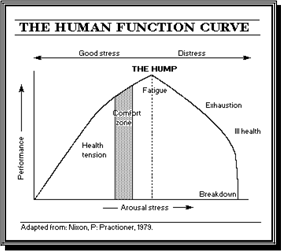
Because it was apparent that most people viewed stress as some unpleasant threat, Selye subsequently had to create a new word, stressor, to distinguish stimulus from response. Stress was generally considered as being synonymous with distress and dictionaries defined it as “physical, mental, or emotional strain or tension” or “a condition or feeling experienced when a person perceives that demands exceed the personal and social resources the individual is able to mobilize.” Thus, stress was put in a negative light and its positive effects ignored. However, stress can be helpful and good when it motivates people to accomplish more.
As illustrated to the left, increased stress results in increased productivity – up to a point, after which things go rapidly downhill. However, that point or peak differs for each of us, so you need to be sensitive to the early warning symptoms and signs that suggest a stress overload is starting to push you over the hump. Such signals also differ for each of us and can be so subtle that they are often ignored until it is too late. Not infrequently, others are aware that you may be headed for trouble before you are.
Any definition of stress should therefore also include good stress, or what Selye called eustress. For example, winning a race or election can be just as stressful as losing, or more so. A passionate kiss and contemplating what might follow is stressful, but hardly the same as having a root canal procedure.
Selye struggled unsuccessfully all his life to find a satisfactory definition of stress. In attempting to extrapolate his animal studies to humans so that people would understand what he meant, he redefined stress as “The rate of wear and tear on the body”. This is actually a pretty good description of biological aging so it is not surprising that increased stress can accelerate many aspects of the aging process. In his later years, when asked to define stress, he told reporters, “Everyone knows what stress is, but nobody really knows.”
As noted, stress is difficult to define because it is so different for each of us. A good example is afforded by observing passengers on a steep roller coaster ride. Some are hunched down in the back seats, eyes shut, jaws clenched and white knuckled with an iron grip on the retaining bar. They can’t wait for the ride in the torture chamber to end so they can get back on solid ground and scamper away. But up front are the wide-eyed thrill seekers, yelling and relishing each steep plunge who race to get on the very next ride. And in between you may find a few with an air of nonchalance that borders on boredom. So, was the roller coaster ride stressful?
The roller coaster analogy is useful in explaining why the same stressor can differ so much for each of us. What distinguished the passengers in the back from those up front was the sense of control they had over the event. While neither group had any more or less control their perceptions and expectations were quite different. Many times we create our own stress because of faulty perceptions you can learn to correct. You can teach people to move from the back of the roller coaster to the front, and, as Eleanor Roosevelt noted, nobody can make you feel inferior without your consent. While everyone can’t agree on a definition of stress, all of our experimental and clinical research confirms that the sense of having little or no control is always distressful – and that’s what stress is all about.
The following websites were referenced in researching this book:
From article The American Institute of Stress
Stress is the feeling of being under too much mental or emotional pressure.
Pressure turns into stress when you feel unable to cope. People have different ways of reacting to stress, so a situation that feels stressful to one person may be motivating to someone else.
Many of life’s demands can cause stress, particularly work, relationships and money problems. And, when you feel stressed, it can get in the way of sorting out these demands, or can even affect everything you do.
Stress can affect how you feel, think, behave and how your body works. In fact, common signs of stress include sleeping problems, sweating, loss of appetite and difficulty concentrating.
You may feel anxious, irritable or low in self esteem, and you may have racing thoughts, worry constantly or go over things in your head. You may notice that you lose your temper more easily, drink more or act unreasonably.
You may also experience headaches, muscle tension or pain, or dizziness.
Stress causes a surge of hormones in your body. These stress hormones are released to enable you to deal with pressures or threats – the so-called "fight or flight" response.
Once the pressure or threat has passed, your stress hormone levels will usually return to normal. However, if you're constantly under stress, these hormones will remain in your body, leading to the symptoms of stress.
Managing stress in daily life
Stress is not an illness itself, but it can cause serious illness if it isn't addressed. It's important to recognise the symptoms of stress early. Recognising the signs and symptoms of stress will help you figure out ways of coping and save you from adopting unhealthy coping methods, such as drinking or smoking.
Spotting the early signs of stress will also help prevent it getting worse and potentially causing serious complications, such as high blood pressure.
There is little you can do to prevent stress, but there are many things you can do to manage stress more effectively, such as learning how to relax, taking regular exercise and adopting good time-management techniques.
Studies have found that mindfulness courses, where participants are taught simple meditations across a series of weeks, can also help to reduce stress and improve mood.
Read more about mindfulness.
When to see your GP about your stress levels
If you've tried self-help techniques and they aren't working, you should go to see your GP. They may suggest other coping techniques for you to try or recommend some form of counselling or cognitive behavioural therapy.
If your stress is causing serious health problems, such as high blood pressure, you may need to take medication or further tests.
Mental health issues, including stress, anxiety and depression, are the reason for one-in-five visits to a GP.
Recognising your stress triggers
If you're not sure what's causing your stress, keep a diary and make a note of stressful episodes for two-to-four weeks. Then review it to spot the triggers.
Things you might want to write down include:
the date, time and place of a stressful episode
what you were doing
who you were with
how you felt emotionally
what you were thinking
what you started doing
how you felt physically
a stress rating (0-10 where 10 is the most stressed you could ever feel)
You can use the diary to:
work out what triggers your stress
work out how you operate under pressure
develop better coping mechanisms
Doctors sometimes recommend keeping a stress diary to help them diagnose stress.
Take action to tackle stress
There's no quick-fix cure for stress, and no single method will work for everyone. However, there are simple things you can do to change the common life problems that can cause stress or make stress a problem. These include relaxation techniques, exercise and talking the issues through.
Find out more by checking out these 10 stress busters.
Get stress support
Because talking through the issues is one of the key ways to tackle stress, you may find it useful to attend a stress management group or class. These are sometimes run in doctors’ surgeries or community centres. The classes help people identify the cause of their stress and develop effective coping techniques.
Ask your GP for more information if you're interested in attending a stress support group. You can also use the search directory to find emotional support services in your area.
Read how 'workaholic' Arvind learned to deal with stress
The following websites were referenced in researching this book:
If you’ve learned nothing from reading this book, we
hope you realize and understand that there is NO WAY to
completely eliminate stress from your life. What you can do
is to learn how to make that stress work FOR you.
Stress management isn’t as difficult as it might actually
seem. However, we can’t emphasize this next point enough.
If you think you have too much stress in your life, it may be
helpful to talk with your doctor, spiritual advisor, or local
mental health association. Because reactions to stress can
be a factor in depression, anxiety and other disorders, they
may suggest that you visit with a psychiatrist, psychologist,
social worker, or other qualified counselor.
We don’t want to present ourselves as medical
professionals. All we want to do is give you some tools to
implement in your life to help you better cope with those
things that make us overwhelmed and feel out of control.
You may also want to look into time management tools
in order to get rid of some of your stressors. When we feel
like we don’t have enough time to do the things that need to
be done, that creates more stress and can lead to anxiety
which, believe me, you don’t want to have!
Stress management tips are simple cost effective
methods to effectively check stress. They can be practiced
anywhere and at anytime. Well, almost!
If you feel you are in need of help, do not hesitate. You
might not be correct always. The cause of your stress might
be for no reason at all. But it might be physical in its roots.
Someone else might be able to solve it easily. Understand
your limitations and it can relieve stress to a large extent.
Stress is a normal part of life. In small quantities,
stress is good -- it can motivate you and help you be more
productive. However, too much stress, or a strong response
to stress, is harmful.
It can set you up for general poor health as well as
specific physical or psychological illnesses like infection,
heart disease, or depression. Persistent and unrelenting
stress often leads to anxiety and unhealthy behaviors like
overeating and abuse of alcohol or drugs.
Just like causes of stress differ from person to person,
what relieves stress is not the same for everyone. In
general, however, making certain lifestyle changes as well
as finding healthy, enjoyable ways to cope with stress helps
most people. I hope that I’ve given you some great ways of
dealing with the stress that we all feel!
Above all, remember that you are in no way alone in
this battle. There are hundreds of thousands of people out
there who feel overwhelmed and nearly completely out of
control. That’s why we wanted to give you this book. So
you can find peace within yourself and realize that we’re all
on this big blue marble for a reason.
You are too! Enjoy it and live life to its fullest. And
when you feel yourself stressed out or beset with a panic
attack, relax, breathe through it, and know that there are
many, many people who know exactly how you feel.
I like Bobby McFarrin’s philosophy best of all – “Don’t
Worry, Be Happy!”
The following websites were referenced in researching this book:
www.articlegarden.com
www.ezinearticles.com
www.bzx.net
www.about.com
www.copingtoday.com
Coffee breaks aren’t the only times when you can take
a moment for yourself. Experience has actually taught me
that coffee (or smoke) breaks can actually add to the stress
you feel when you’re at work.
Some of the suggestions we’ve given you in this book
can certainly be practiced at work, but, unfortunately, others
cannot. Here’s a tried and true method to help you relax at
work.
First and foremost, find a place to sit. Sit up straight
with your back against the back of your chair, your feet flat
on the floor, and your hands resting lightly on your thighs.
If possible, close your eyes. You may do the exercise
without closing your eyes, but closing your eyes will help
you relax a bit more. Do not clench your eyes shut. Let your
eyelids fall naturally.
Breathe in slowly through your nose, counting to 5.
Hold the breath for a count of 5. Breathe out slowly,
counting to five. Repeat.
This exercise is performed by tensing and holding a set
of muscles for a count of 5, and then relaxing the set of
muscles for a count of 5.
When you tense each muscle set, do it as hard as you
can without hurting yourself. When you release the hold, be
as relaxed as possible.
Begin by tensing your feet. Do this by pulling your feet
off the floor and your toes toward you while keeping your
heels on the floor. Hold for a slow count of 5. Release the
hold. Let your feet fall gently back. Feel the relaxation. Think
about how it feels compared to when you tensed the
muscles. Relax for a count of 5.
Next tense your thigh muscles as hard as you can. Hold
for a count of 5. Relax the muscles and count to 5.
Tighten your abdominal muscles and hold for a count of
5. Relax the muscles for a count of 5. Be sure you are
continuing to sit up straight.
Tense your arm and hand muscles by squeezing your
hands into fists as hard as you can. Hold for a count of 5.
Relax the muscles completely for a count of 5.
Tighten your upper back by pushing your shoulders
back as if you are trying to touch your shoulder blades
together. Hold for a count of 5. Relax for a count of 5.
Tense your shoulders by raising them toward your ears
as if shrugging and holding for a count of 5. Relax for a
count of 5.
Tighten your neck first by gently moving your head
back (as if looking at the ceiling) and holding for 5. Relax for
5. Then gently drop your head forward and hold for 5. Relax
for a count of 5.
Tighten your face muscles. First open your mouth wide
and hold for 5. Relax for 5. Then raise your eye brows up
high and hold for 5. Relax for 5. Finally clench your eyes
tightly shut and hold for 5. Relax (with eyes gently closed)
for 5.
Finish the exercise with breathing. Breathe in slowly
through your nose, counting to 5. Hold the breath for a
count of 5. Breathe out slowly, counting to five. Repeat 4
times. And that’s it!
Perform this exercise whenever you need to relax,
whether it's on a plane or in a car or anyplace else you may
be sitting. Because this exercise may be very relaxing, it
should not be performed while driving.
Over time, if performed regularly, this exercise will help
you recognize tension in your body. You will be able to relax
muscles at any time rather than performing the entire
exercise. Perform at least twice a day for long-term results.
You may develop your own longer relaxation exercise
by adding more muscle groups. Pinpoint your own areas of
tension then tense and relax these areas in the same way.
Maximize the relaxation benefits of this exercise by
visualizing a peaceful scene at the end of the exercise.
Visualize a scene - a place where you feel relaxed - in detail
for at least 5 minutes. Remember the happy place? Go
there and enjoy it!